
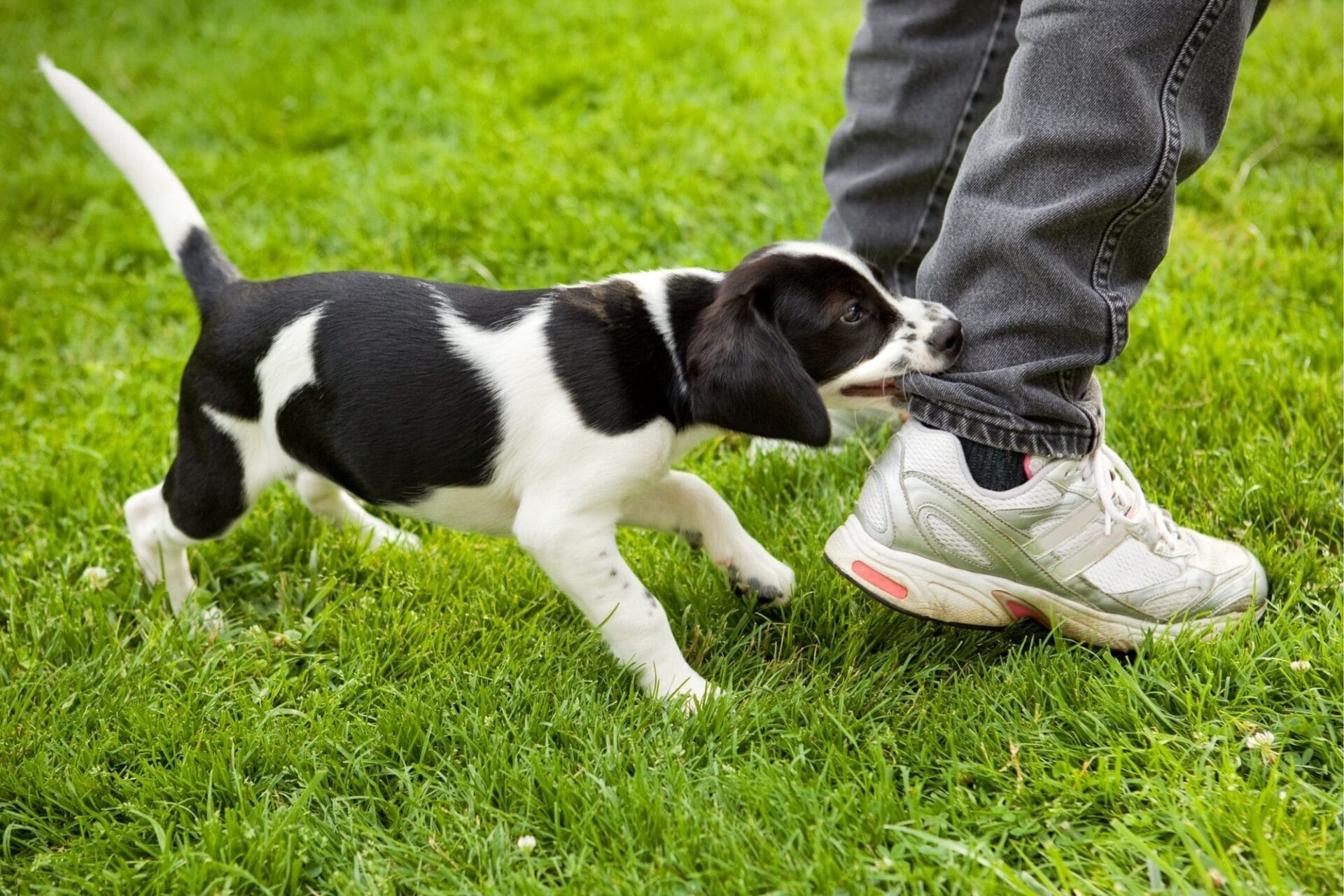
If you have a puppy at home, you've probably been caught chewing on your slippers, a piece of furniture... or your own hands. Although it may seem like a simple game, it is normal for you to wonder if this chewing is a sign of aggression or if you should be worried.
The good news is that you are not aloneand this behaviour is completely normal. But it is also true that can and should be educated to avoid problems in the future.
At GUAU EventsWe help you understand your dog's behaviour from an approach that respects their biology and is fun to apply. Read on to find out why puppies bite and how you can guide them to learn to interact without harm.
Why does a puppy bite?
Dogs, especially when they are small, explore the world with their mouths. Biting is not a synonym for aggression, but part of their natural development. Here are the most common reasons:
🔹 DentitionLike human babies, puppies go through a process of tooth change. Biting relieves gum discomfort.
🔹 Sensory explorationDogs do not have prehensile hands, so they use their mouths to get to know textures and shapes.
🔹 Natural hunting instinctMany puppies enjoy "tearing up" toys, stuffed animals or even paper as part of their prey drive.
🔹 Social gameIn the litter, they learn to regulate the strength of the bite by playing with their siblings. If one bites too hard, the other complains and the game stops. In this way they learn to control their jaw pressure.
When your puppy bites your hands, is doing the same as he would do with his littermatesbut with your skin, which is more delicate.
How do you teach your puppy not to bite you?
The key is setting clear, consistent and respectful boundaries. Here are some practical tips that we use in our training programmes:
✅ Offers toys suitable for chewingAlways have 2 or 3 safe and attractive toys. Rotate them frequently to keep them interested.
✅ Reinforce the positivePraise your puppy when he chooses a toy for himself instead of your hands.
✅ Bringing the game back on trackUse stuffed animals or strings to play with. Never use your hands as "prey".
✅ Emits a clear signalIf he bites your hand, let out a loud "Ouch" and stop the game for a few seconds. That way he understands that he has crossed a boundary.
✅ Take breaks if necessaryIf you don't lower the intensity, end the game and walk away for a moment. This teaches self-control.
When will it stop biting?
Biting behaviour improves when teething ends at around 6 months. But if it has not been worked well, it can be extended further, especially during canine adolescence.
⚠️ AttentionIf your dog is over 6 months old, breaks objects or does not control the intensity of play, there may be a problem of excess energy or even anxiety.
What if I'm worried about him being aggressive?
Many caregivers wonder if intense biting may be a sign of future aggression. The reality is that aggression is not born, it develops if emotions are not managed properly from puppyhood.
💡 Prevention is keyAt GUAU Events we work on emotional management through play and socialisation. We teach them to channel frustration, emotion and excitement in a healthy way.
🔸 It allows you to win sometimes in the game: it helps to maintain your confidence without excessive frustration.
Lower the intensity if he growls or gets overexcited: play should be fun, but also balanced.
🔸 Avoid punishments or shouting: they do not teach, they only confuse or generate fear.
Do you need professional help?
If you feel you can't control the biting, if your puppy is very restless or if you simply want to educate him without making mistakes from the beginning, count on us.
At GUAU Events we offer you:
🐾 Super fun training sessions
🐾 Early education for puppies
🐾 Socialisation and emotional management programmes
🐾 Fun and educational activities for the whole family
👉 Because dog training not only prevents problems, it also strengthens the bond between you and your dog.
🔗 Contact us today and start on the road to a happy and balanced coexistence.


